
Experienced Trustee Program
The program is in its early stages and is constantly evolving with our experienced trustees.

Target group
Young people aged 10-18 who exhibit high-risk behavior, i.e. constant violence directed against themselves and/or others.
Target group concern
Few positive experiences with adults and/or peers
Self-regulation skills need support
Disapproval from adults about their spending time and communication style
They are not listened to, understood, or accepted.
In addition, pain, loneliness, fear, hopelessness


Value proposition
We give you the opportunity to be heard, seen, and accepted by someone who truly understands what you are going through.
Program content
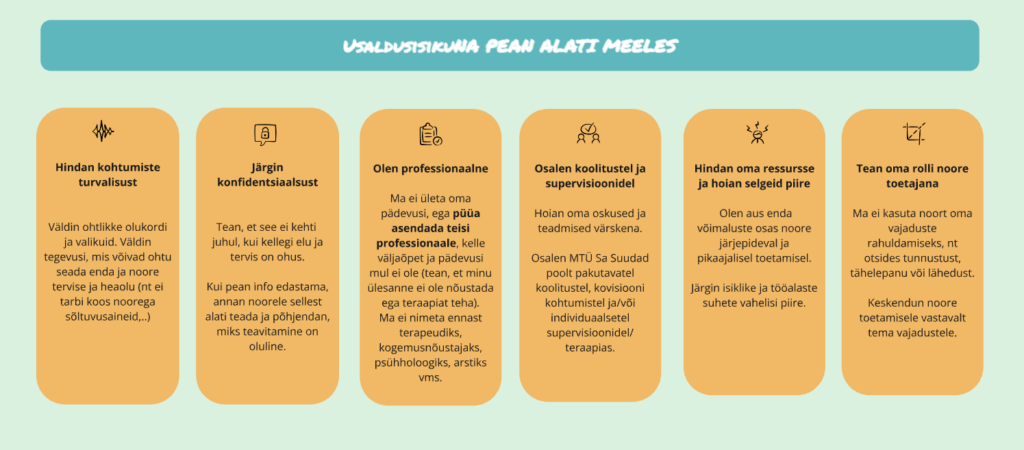
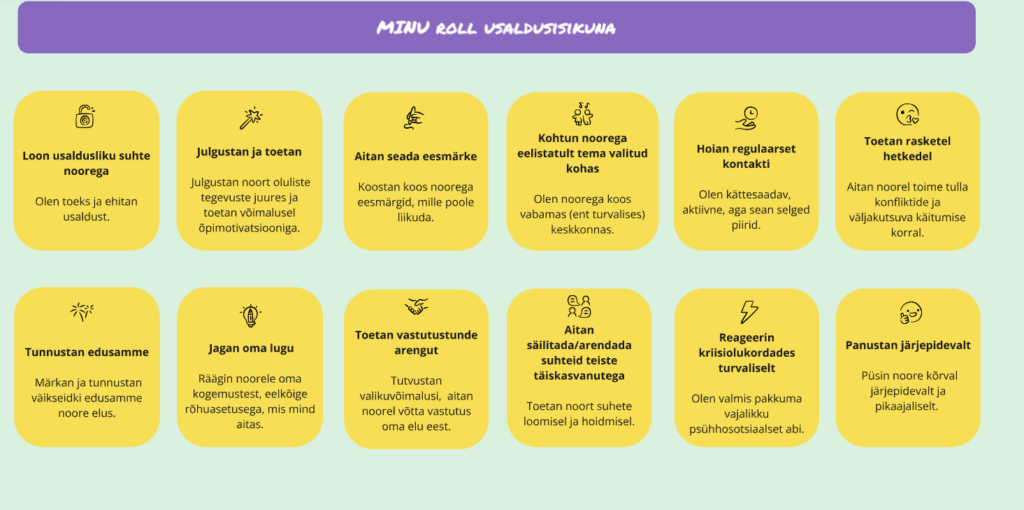
An experienced confidant's work with young people combines emotional support, empowerment and guidance. The confidant helps young people to achieve better coping with themselves, in their relationships with others and in other aspects of life (school, leisure activities). The confidant helps young people through consistent spending time together develop self-regulation skills and hope for a better future. The role of the confidant is also to be a bridge between the young person and other adults/specialists, i.e. to help encourage the young person to receive support and help from other specialists if necessary (e.g. child protection, therapists, school staff, etc.).
Experienced trustees
Young adults (ages 19-39) who have experienced difficulties in life, or who have ever engaged in high-risk behavior. An experienced confidant is a trained and supported young person who, in turn, offers support to the young person through understanding and can share their own experiences that led to change.
An experienced confidant has gone through difficult life periods themselves, which is why they are able to better understand young people, gain their trust, and serve as a bridge to other necessary supports.
As of May 2026, Sa Suudad MTÜ has 6 experienced trustees.
Program objective
Consistent Through the support of a trusted person, the young person's self-regulation skills are strengthened, trust in themselves and other people, including specialists, grows, and relationships with family and friends improve - which leads to a reduction in risk behavior.
What did we do as part of the NULA program?
- Interviews with young people. In total, we conducted over 10 interviews with young people (aged 14-26) who have had or are engaging in risky behaviour. The purpose of the interviews was to better understand the young people's experiences, experiences, expectations, including ways to get help and their needs.
- Interviews with experienced counselors. In total, we conducted 4 interviews with experiential counselors, with the aim of understanding what experiential counseling work looks like today and what is important to remember when developing the program ourselves.
- Mapping the client journey . We mapped the journey of the target group, the confidant and the NGO at a general level, from joining the program to the actual program activities. We familiarized ourselves with existing similar programs in Estonia and abroad, discussed with experts in the field in Estonia and Finland, and read and analyzed a lot of scientific literature.
- Workshops with young people. We met several times with seven young people who want to become trustees in the future. We introduced them to insights from the interviews, the idea of the trustee program, the program's fundamentals and vision. Together with the young people, we created a trustee role description, value proposition, and mapped out the skills, knowledge and personal qualities needed to be a trustee.
- Created with experience trustee program prototype, including basic principles, trustee role description, value proposition, description of trustee profile (including skills), prototype of training methodology and content, description of trustee support system, steps for recruiting trustees, initial impact assessment methodology.
What else has been done and needs to be done?
- Find additional funding and collaboration partners to implement the program (in terms of enabling recreational activities)
- Ongoing support and training of experienced trustees
- Consultation with the target group of the program and validation of different parts of the program (DONE)
- Develop a comprehensive impact assessment strategy (DONE)
- Finding initial partners (with whom to pilot) (DONE)
- Finding and training experienced trustees (DONE)
- Finding mentors for experienced trustees (DONE)
Trainings that MTÜ Sa Suudad has organized for trustees:
- Experiential Counseling Training (August 2025 – December 2025, plus internship). Total 195 ECTS credits
- Motivational Interviewing (February 2026) 12 credit hours
- Experienced Trustee Program Training (March 2026) 12 credit hours
- Trauma training (May 2026) 12 credits/h
- Youth-centered approach (June 2026) 12 credits/hour
March 2025
Completion of the NULA program
Applying for funding from the Estonian Council for the Promotion of Education
March – September 2025
Preparing for piloting
- Finding confidants
- Training of trustees (August 2025-December 2025)
September -December 2025
Preparations
Training of trustees
Completing the Trustee Program with Potential Trustees
Finding partners, including young people, for piloting
Preparing the impact assessment
January 2026 – May 2026
Preparing to start the program
Finding a cooperation partner, preparing materials, completing training courses
May 2026 – …
Getting started with the program
Conducting a pilot program and continuous evaluation, including adaptation if necessary
You can read more about the project description HERE.
The project is funded by the Civil Society Foundation through the startup grant of the Civil Society Smart Solutions.
